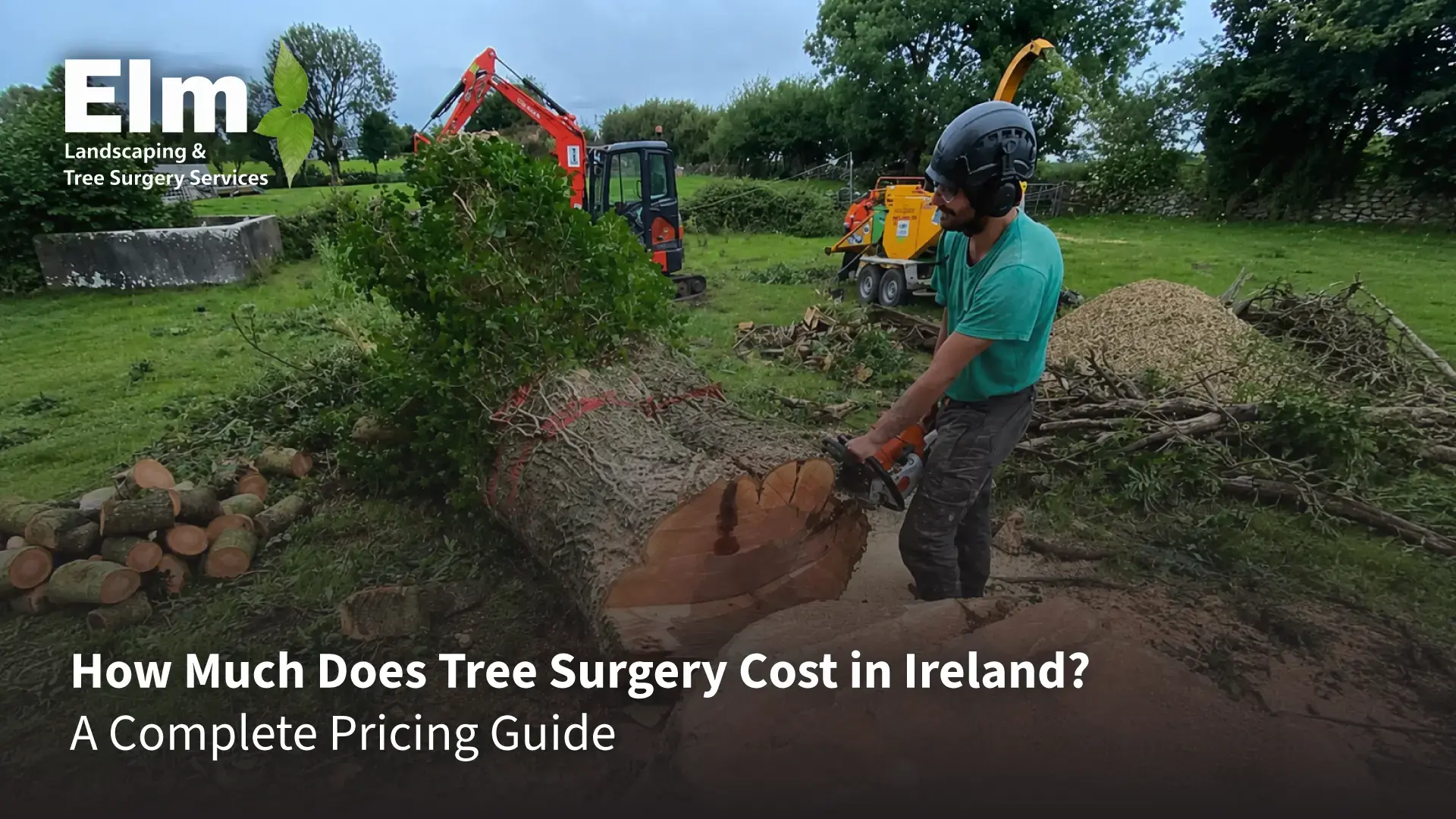
Tree surgery in Ireland typically starts at €300 for a small removal and runs to €3,000 or more for a large, complex tree. But those numbers alone won’t help you budget. Two jobs described exactly the same way can be priced €800 apart, and the reason is usually something the contractor spotted on-site that no quote form captures. That gap matters.
What follows are real figures, real variables, and the things contractors don’t always volunteer before you sign. Written by a team that has been doing this work across Ireland since 2008. We’ve seen every surprise, and every way a quote can go sideways.
How Much Does Tree Surgery Cost in Ireland?
These are realistic tree surgery prices across Ireland in 2026. The average cost runs from around €400 for a straightforward small removal to €1,500 or more for a medium tree with access complications. Figures are drawn from 17 years of work by a team holding ISA and Arboricultural Association accreditation.
Service | Typical Price Range |
|---|---|
Minimum call-out charge | €200 – €300 |
Small tree removal (under 20ft / 6m) | €300 – €700 |
Medium tree removal (20–40ft / 6–12m) | €700 – €1,200 |
Large tree removal (40–60ft / 12–18m) | €1,200 – €3,000 |
Extra large tree removal (60ft+ / 18m+) | €3,000 – €5,000+ |
Crown reduction | €300 – €900 |
Crown thinning | €250 – €700 |
Pollarding | €300 – €800 |
Dead wood removal | €200 – €600 |
€150 – €500 | |
Tree pruning / trimming (team rate) | €120 – €150 per hour |
Emergency call-out | €300 – €600+ (dependent on urgency and time of day) |
Commercial site clearance | Priced on survey |
Most professional tree surgeons won’t give you a fixed price over the phone. That’s not evasion. The price genuinely changes based on what they see when they arrive: access routes, tree condition, proximity to structures, equipment required. For anything other than a small, straightforward job, expect a site visit before a firm figure is agreed.

What Affects the Cost?
The complexity of the job, the species of tree, and what’s surrounding it on the day all affect what you’ll pay.
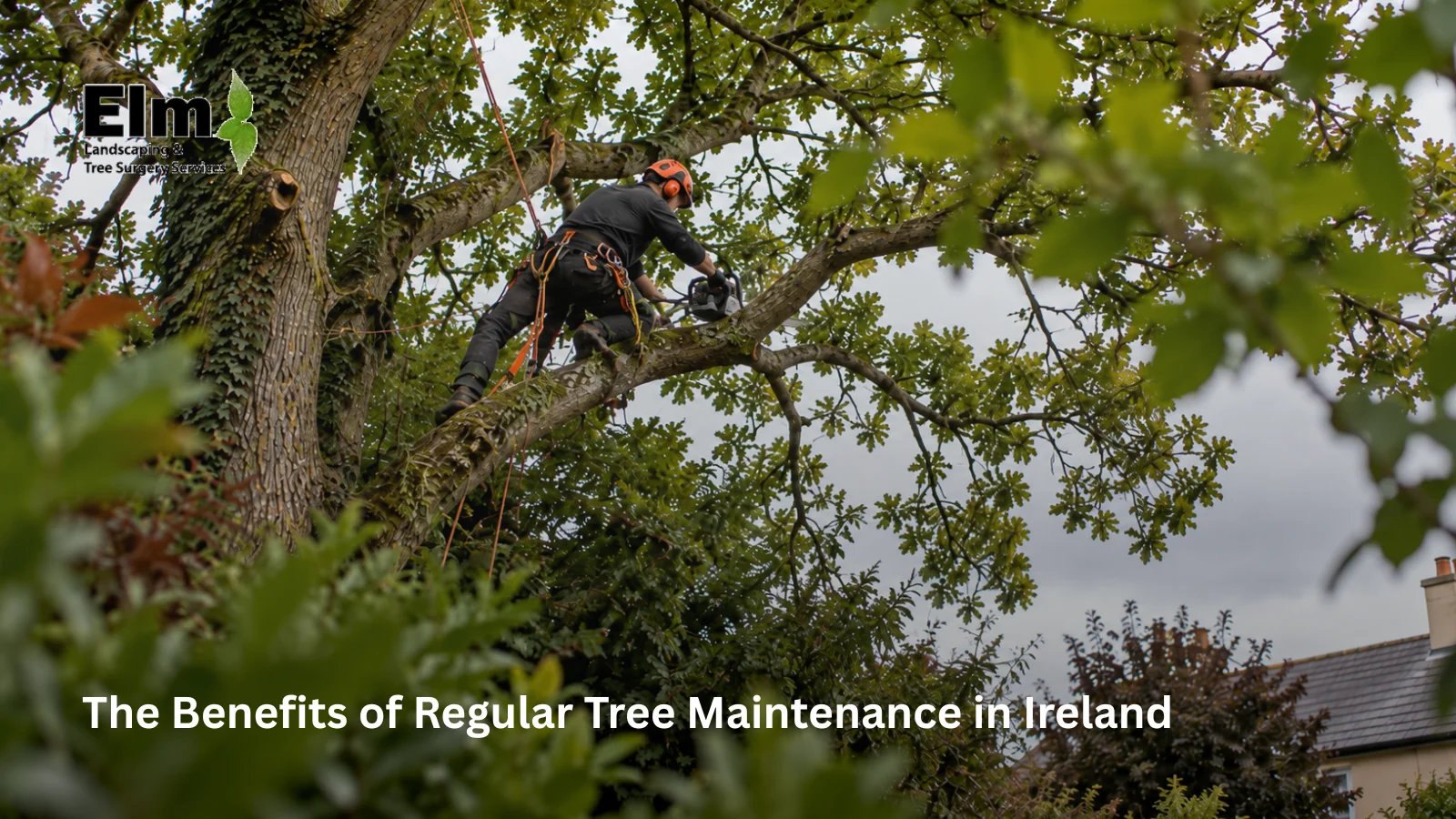
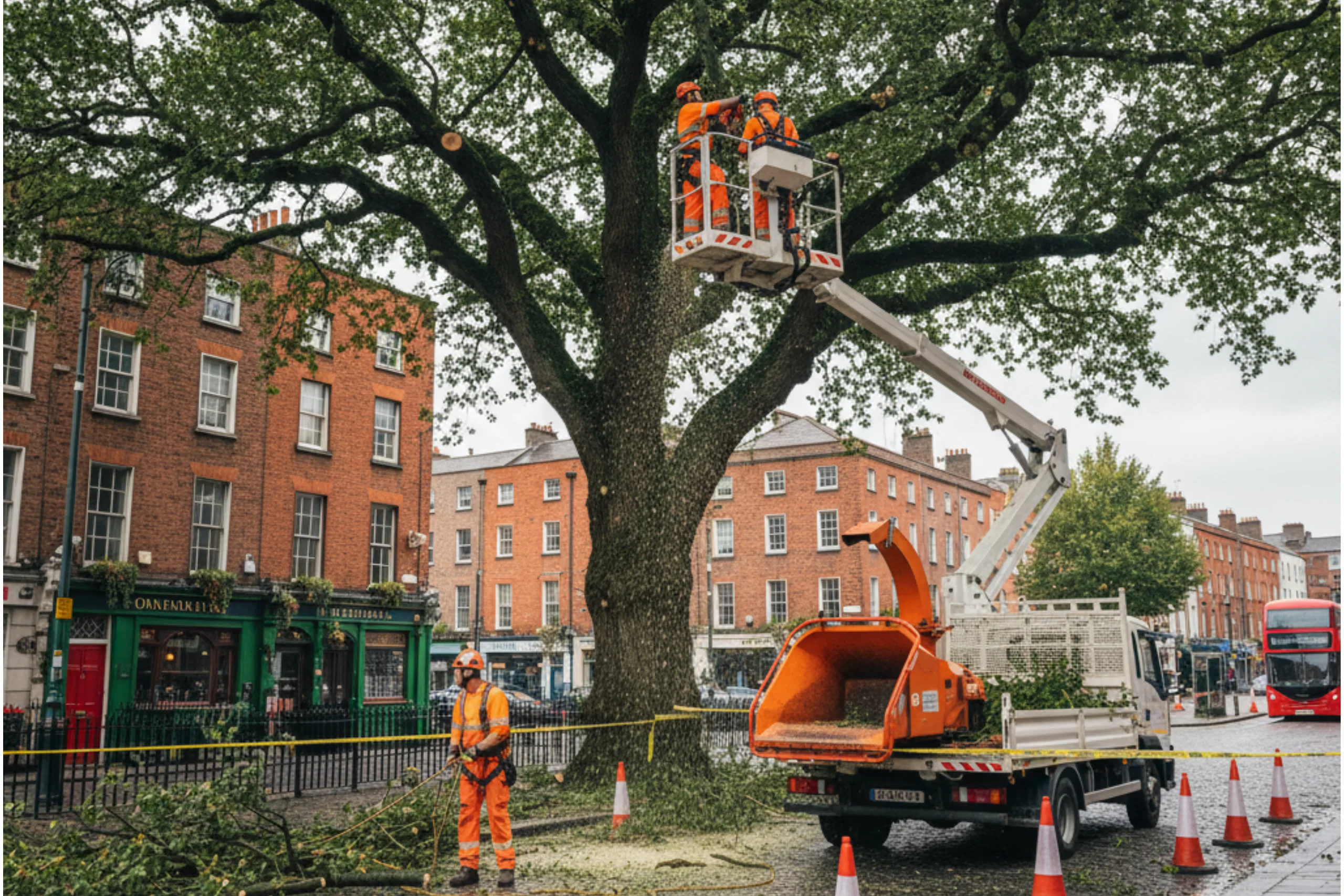
Tree size is the obvious one. A 6-metre birch in an open garden is a half-day job. A 15-metre beech close to a boundary wall is something else entirely: larger team, controlled sectional felling, chip truck on-site, sometimes a crane where rope access alone isn’t safe. Bigger trees cost more because they take longer, require more people, and carry more risk. Simple.
Access changes everything. If a crew can get a chipper to within 10 metres of the tree, you’re in the straightforward category. If they’re carrying sections through a narrow passage, clearing debris from a greenhouse roof, or parked 200 metres away on a public road, every complication adds time. And time is what you’re paying for.
What’s nearby matters as much as what the tree is. Trees close to buildings, fences, overhead lines, or anything breakable require careful rigging and sectional removal rather than a clean fell. That difference shows up in the quote.
Health, season, location. A diseased or structurally compromised tree changes the risk profile and often the method. Winter is cheaper: trees are dormant, demand drops, and most operators have more availability. Location matters too. Cork, Limerick and Galway generally run below Dublin on like-for-like jobs, and rural areas can attract a travel surcharge for smaller work.


What About Stump Removal?
Stump grinding is regularly left out of initial quotes, then comes as a surprise when homeowners realise the stump is still there three days later. Prices typically run from €150 for a small stump to €400 to €500 for a large, deeply rooted one. For a full breakdown of how much stump grinding costs across different stump sizes and scenarios, we’ve covered that in detail separately.
If you’re planning to lay a patio or driveway over the area, the stump needs to go well below the surface. Whoever is quoting needs to know that upfront. And if you’re having multiple trees removed in one visit, bundle the stump grinding into the same job. It almost always costs less than a return visit.
Pruning, Crown Work and Trimming Costs
These services are regularly confused with each other. The distinction matters for the health of the tree and for what ends up on the invoice.
Crown reduction brings the tree down to a smaller but still natural shape. Done correctly, it doesn’t harm the tree. The critical point: crown reduction is not topping. Topping cuts at an arbitrary height, ignoring natural growth points. It looks dramatic, causes long-term structural problems, and produces weakly attached regrowth that makes the tree more dangerous over time. If a contractor suggests topping as the solution, walk away.
Crown thinning removes selected branches from within the canopy. The size stays the same; the goal is more light through the tree and better airflow to reduce disease risk. Deadwood removal clears dead or dying branches. Both a safety risk and a source of decay that can spread. Usually done alongside a general crown inspection rather than as a standalone job.
Pruning is charged by team time, typically €120 to €150 per hour. Most smaller jobs run €300 to €500. A full day on a mature specimen tree will be higher.
Tree Size | Typical Pruning / Trimming Cost |
|---|---|
Small (under 6m / 20ft) | €150 – €350 |
Medium (6–12m / 20–40ft) | €300 – €600 |
Large (12–18m / 40–60ft) | €500 – €900 |
Extra large (18m+ / 60ft+) | €800 – €1,500+ |
Multi-tree job (same visit) | Reduced rate — ask for a combined quote |
Emergency pruning, work over structures, or specialist species (veteran oaks, protected trees) will sit toward the top of the range. If you’re unsure which service your tree needs, a site assessment will tell you. It can save you from paying for the wrong job.

Tree Removal and Planning Law
For most trees in a private residential garden, no planning permission is required. The exceptions are trees covered by a Tree Preservation Order (TPO), or trees protected by a planning condition attached to your property’s original planning permission. Carrying out work on a TPO tree without consent is a criminal offence. The fines are real. It happens more often than people expect, usually because no one checked before starting.
If you live near a conservation area or your property carries planning conditions, contact your local authority before booking any work. A reputable tree surgeon will ask about this. If yours doesn’t, you should.
One restriction that catches people out regardless of TPO status: Irish guidance restricts tree work during bird nesting season, generally 1 March to 31 August. A qualified arborist flags this before scheduling. An unqualified one may not.
Commercial Tree Surgery Cost
Commercial tree surgery runs differently from residential. If you’re a facilities manager, property developer, or business owner with grounds to maintain, the underlying variables are the same but the scale, liability exposure, and contracting structure change the picture significantly.
Most commercial clients work on one of two arrangements: a one-off project quote for clearance or site preparation, or an ongoing maintenance contract. For multi-tree projects, pricing is done by survey. Always. None of it can be assessed accurately from a phone call.
The main advantage of a maintenance contract is predictability. Without one, a storm in January means an unexpected invoice for €1,400 and a three-week wait for a crew. With one, you have a planned response and documented tree surveys that matter if there’s ever a liability question. If you manage a site in Clare, Limerick, Galway, Tipperary, or further afield, a free site survey is the right starting point.
How to Choose a Tree Surgeon
The price difference between a qualified, insured tree surgeon and an unqualified operator can be €200 to €300 on a single job. The liability exposure if something goes wrong is significantly larger than that.
Tree surgery is genuinely high-risk work. Co-dominant stems (two main trunks sharing a weak union) can split under load without warning. A saw that binds in a tension cut kicks back immediately. A qualified arborist holds certification from the ISA (International Society of Arboriculture) or the Arboricultural Association. Not courtesy titles, but assessed competency in rigging, tree biology, hazard assessment, and safe working at height.
Before any work starts, ask for proof of public liability insurance. A standard residential job should be covered to at least €2.6 million. Ask to see the certificate. Some home insurance policies also require you to use qualified, insured contractors. A claim arising from an uninsured operator can be declined. One who hesitates at that request is telling you something.
Elm Landscaping is ISO certified and fully insured. Request our documentation before any work begins. We’ll provide it without hesitation.
What a Good Quote Looks Like
Before you agree to anything, these items should be clearly stated in writing:
- The scope of work: exactly which trees, which services, what the finished result will look like
- Whether waste removal and disposal is included
- Whether stump grinding is included or priced separately
- The insurance position, including public liability and employer’s liability
- An approximate timeline for when the work will be carried out
- The name of whoever will be on-site
If any of these are missing, ask for them before you sign off. If you’d like a quote that covers everything on this list, a free site assessment is the right starting point.
Book a Free Site Assessment
If you’ve read this far, a real conversation probably makes more sense than another hour of research. A free site assessment gives you a clear picture of what the job involves, what it will cost, and what order to do things in. No obligation, no guesswork.
Elm Landscaping has been doing this work across Ireland since 2008. Our arborists hold ISA and Arboricultural Association accreditation, and every job is assessed by a qualified arborist before we quote. If the full scope feels like too much at once, we offer a phased approach: priority work first, the rest scheduled in stages when it suits your budget.
Call 065 686 6773 or 087 279 8611 to book your free site assessment, or use the contact form and we’ll come back to you the same day.
The showroom in Ennis is also open if you’d prefer to come in, see examples of our work, and talk it through in person.
Tree surgery isn’t a purchase most people make more than once or twice. Get it right the first time.