You need a tree-felling licence to legally fell a tree in Ireland, unless that tree falls under one of a short list of exemptions written into the Forestry Act 2014. But knowing that rule and knowing which side of it your tree sits on are two different things.
Most people only find out they got it wrong after the tree is already on the ground. Apply for a licence you didn’t need and you’ve lost weeks waiting on a decision you never required. Fell a tree without one and you’re looking at prosecution, a forced replanting order, and a fine that scales per tree, not per job.
Here’s how to work it out before you do.
What Is a Tree Felling Licence?
A tree felling licence is permission granted by the minister for Agriculture, Food and the Marine, under the Forestry Act 2014, to fell or otherwise remove a tree or trees, or to thin a forest for silvicultural reasons.
It’s issued by the Forest Service, the division of the Department of Agriculture that regulates forestry activity across the country.
Ownership doesn’t equal permission. The law separates the two entirely, and felling without a licence or a valid exemption is an offence no matter whose land the tree stands on.
When Do You Need a Tree Felling Licence?
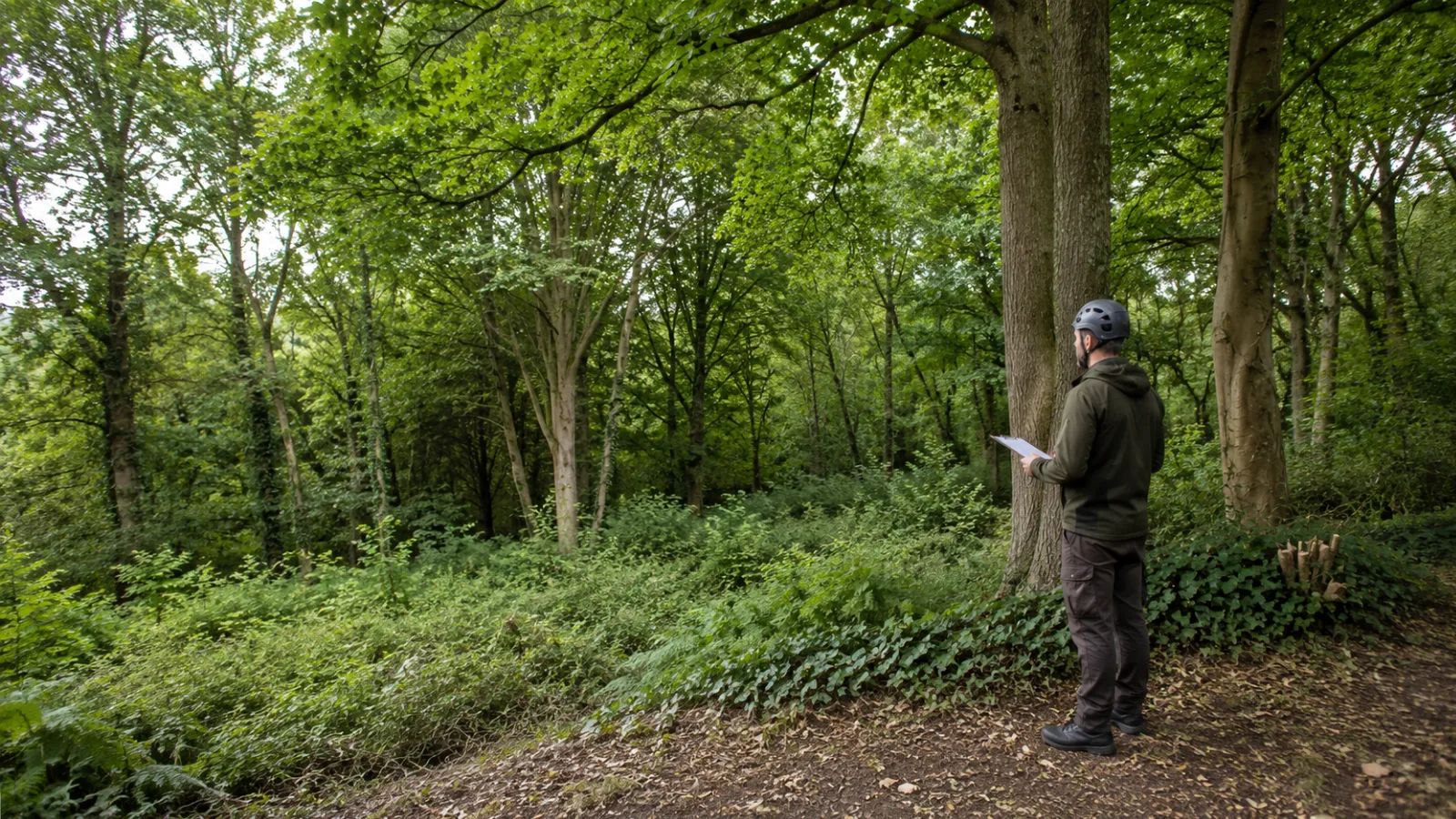
You need one if your land meets the legal definition of forest, or if you’re planning any felling operation at that scale. The Forestry Act 2014 defines forest land as anything with a minimum area of 0.1 hectares and tree crown cover above 20% of the total area, or the potential to reach that at maturity.
If you own or manage land that meets that definition, whether you’re planning a clearfell, a thinning, or work tied to a wind farm site, you’re inside the licensing system from the start. A registered forester can apply on your behalf, and larger operations need a harvest plan submitted alongside the application.
Most residential situations sit outside that definition entirely. A single tree in a garden, however large, rarely meets the forest land threshold. But a tree that isn’t “forest land” isn’t automatically exempt from needing a licence either.
It just moves you into a different part of the same legislation, the exemption list under Section 19.
Which Trees Are Exempt From a Felling Licence?
A tree is exempt from needing a felling licence if it falls under one of the specific circumstances set out in Section 19 of the Forestry Act 2014. The full list of exemptions is covered below, but here’s the nuance most guides skip: a Tree Preservation Order overrides every exemption on that list. If a TPO is attached to a tree, or the tree sits within a protected structure’s curtilage, the 30-metre rule and the diameter rule stop applying.
You still need consent, this time from the local authority rather than the Forest Service. Two different permissions, two different bodies, and most people only discover which one applies to them after they’ve already contacted the wrong one.
The Forest Service still expects to be notified even when you believe an exemption applies. It’s their call to confirm the exemption holds, not yours to assume it does.
TPOs, roadside trees, and neighbour disputes all sit outside the felling licence system entirely. For the full permission rules covering those situations, see our complete guide.
What Is a Tree Preservation Order and Does It Affect You?
A Tree Preservation Order (TPO) is a protection issued by your local planning authority that prevents the cutting down, topping, lopping, or wilful destruction of a tree without prior consent, regardless of whether a felling licence would otherwise be required.
Local authorities can issue a TPO on any tree they consider beneficial to the amenity or environment of the local area.That includes trees on private land. If a TPO has been placed on a tree and you proceed without consent, that is a separate offence from anything under the Forestry Act. The Planning Authority maintains a register of all TPOs in its area.
To check whether any tree on your property is protected by a TPO in County Clare, Limerick, or Galway, contact the Environment or Planning Department of your local council directly.
One call. Do it before any work is planned.
Your planning history matters too. If your property was subject to a grant of planning permission that specified certain trees be retained as a condition, removing those trees without permission from the planning authority is a breach of that condition, regardless of the Forestry Act position.

When Do You NOT Need a Felling Licence?
Section 19 of the Forestry Act 2014 sets out a list of circumstances in which trees can be felled without requiring a licence. These exemptions cover many common residential scenarios.
| Scenario | Condition |
|---|---|
| Tree in an urban area | Urban areas are those comprised of a city, town or borough specified in the Local Government Act 2001 before the Local Government Reform Act 2014. The old boundaries still apply. |
| Within 30 metres of a building | The building must not be a temporary structure, and must have been built before the trees were planted. |
| Within 10 metres of a public road | The tree must be considered dangerous to road users. |
| Hawthorn or blackthorn species | Must be growing in a hedgerow. |
| Apple, pear, plum, or damson species | Must be growing outside a forest. |
| Naturally regenerated tree | Must be less than five years of age, removed from a field as part of normal maintenance of agricultural land, and not part of a hedgerow. |
| Nursery tree | Must be uprooted specifically for replanting elsewhere. |
| Willow or poplar species | Must be grown specifically for fuel under short rotation coppice. |
| Approved for removal in planning permission | Must be outside a forest and indicated on the lodged plans as planned for removal. |
For trees in a hedgerow that are being felled for the purposes of trimming the hedge, an exemption applies provided the tree does not exceed 20 centimetres in diameter measured at 1.3 metres from the ground.
Agricultural holdings have an additional allowance: landowners can remove up to four trees per year, with a total volume not exceeding 12 cubic metres, for use on that holding. The exemption does not apply to trees within the grounds of a protected structure, in a designated conservation area, or forming part of a decorative avenue or ring of trees.
How Do You Apply for a Felling Licence?
A felling licence application costs €20 to submit, confirmed on the official DAFM tree felling licences page. It goes to the Forest Service, formal applications reference Johnstown Castle Estate in Wexford as the department’s base, and larger or forest-scale applications go through screening to check for any effect on a Natura site within 15 kilometres.
That screening exists because felling near a Special Area of Conservation or Special Protection Area can trigger additional environmental assessment before anything proceeds.
Once granted, a licence to fell can run for up to 10 years, with extensions available in some cases. That length matters if you’re managing a woodland or planning phased works over several seasons rather than a single job.
What Are License Fees?
The Forestry (Amendment) Regulations, 2020 (SI No. 417 of 2020) introduced fees for forestry licence applications made from 07/10/2020. Fees are €20 per licence application and payment can be made by sending a valid cheque, bank draft, postal order or money order by post with your application. Do not send bank notes in the post. Such payments must be made payable to Department of Agriculture, Food and the Marine. An application accompanied with payment by cheque, bank draft, postal or money orders, that is found to be invalid, will not be accepted. Third party cheques, bank drafts, postal or money orders cannot be accepted.
What Happens If You Fell a Tree Without a Licence?
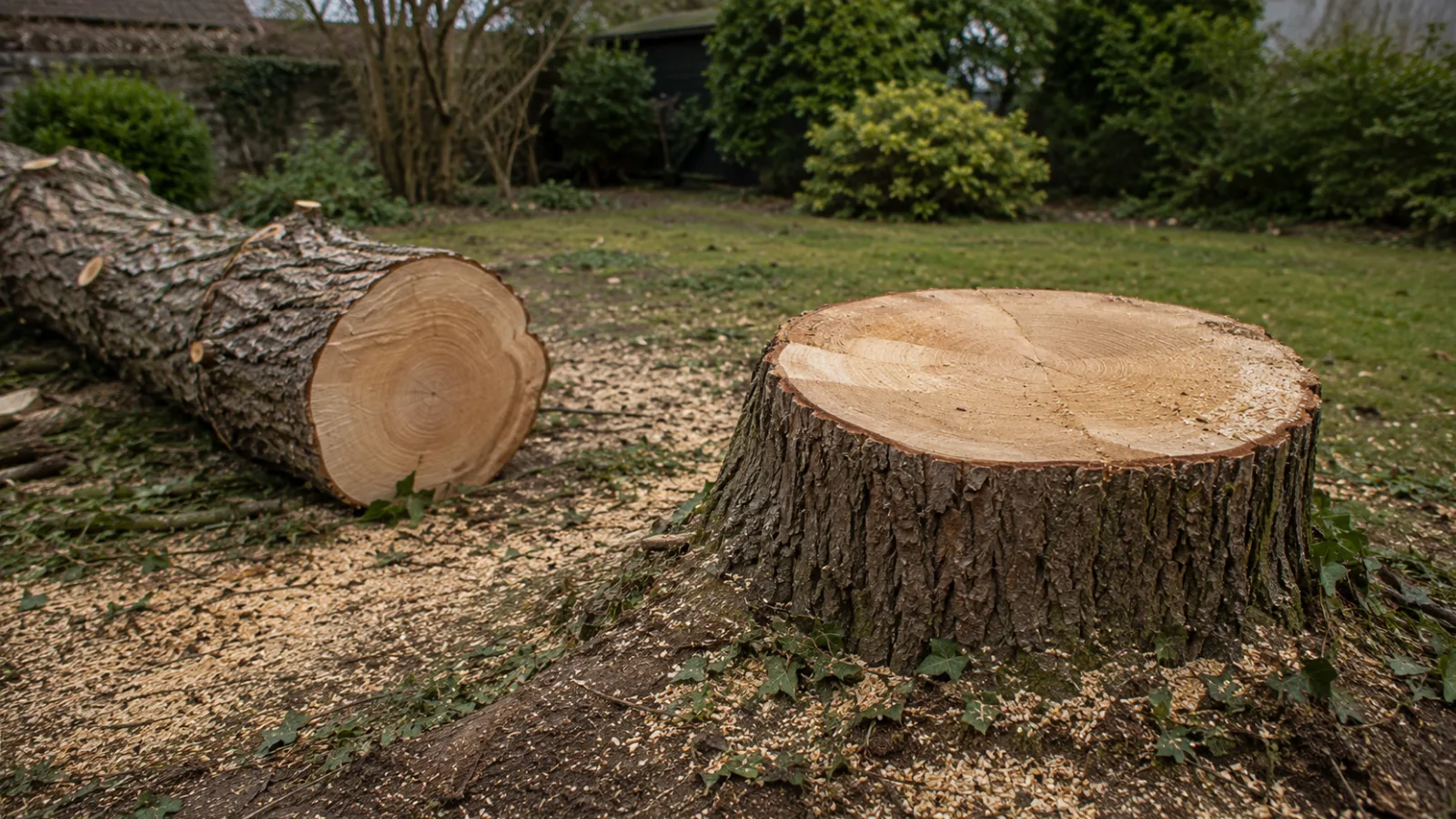
Felling trees without a felling licence, where no exemption applies, is a criminal offence. Authorised officers have powers of entry and enforcement, fixed penalty notices exist for straightforward breaches, and the Minister can issue a replanting order forcing you to restock what you removed.
In more serious cases, equipment and timber used in an unlawful felling can be seized. None of that gets undone by explaining afterward that you didn’t realise the exemption didn’t apply.
The application itself costs €20. Getting it wrong costs considerably more than that: a fine, a replanting bill on top of the original job, and weeks spent sorting it out with the Forest Service while the rest of your project sits idle waiting on a decision that could have been made before anyone picked up a saw.
Should You Hire an Arborist Before Felling a Tree?
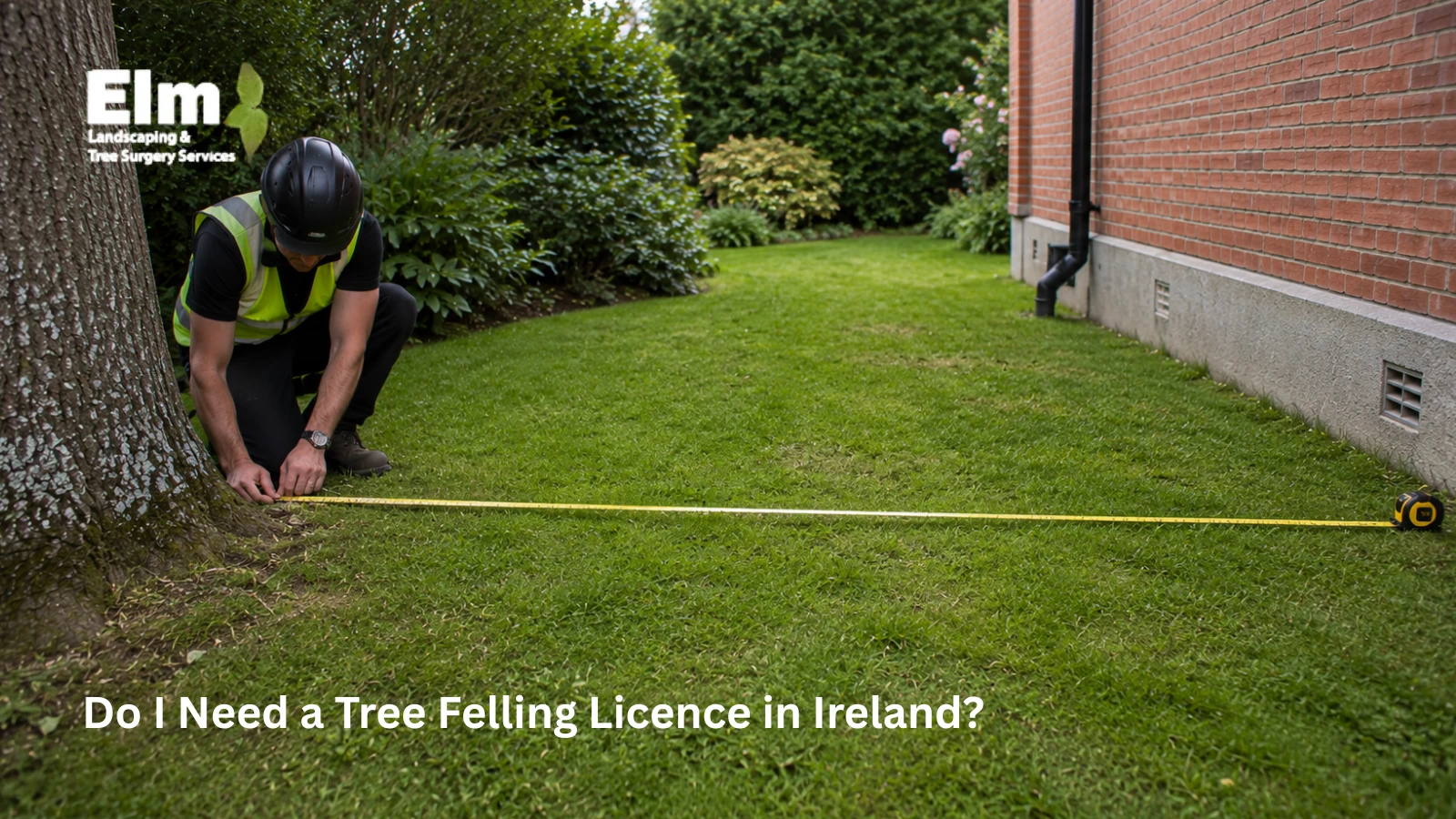
Most people trip up on measurement, not intent. Is that tree genuinely within 30 metres of the building, or does it just look close from the kitchen window?
Is it healthy, or is it structurally compromised enough to change how it’s classified? Those are judgement calls better made by someone who assesses trees for a living than by pacing out a distance with a phone camera, ideally someone with ISA and Arboricultural Association accreditation.
Michael Eustace at Elm Landscaping has spent close to two decades assessing exactly this question for clients across Clare, Limerick, Galway, and Tipperary.
It feels like an extra step when you’re standing there with a saw and a job you want finished today.
The fastest way to find out which side of that line your tree is on is to have someone qualified look at it before a saw comes near it. Get your tree assessed before you fell it, and you’ll know in one visit whether you need a licence, an exemption, or nothing at all.
If felling turns out to be the right call, our tree felling service handles the legal side and the cut together.