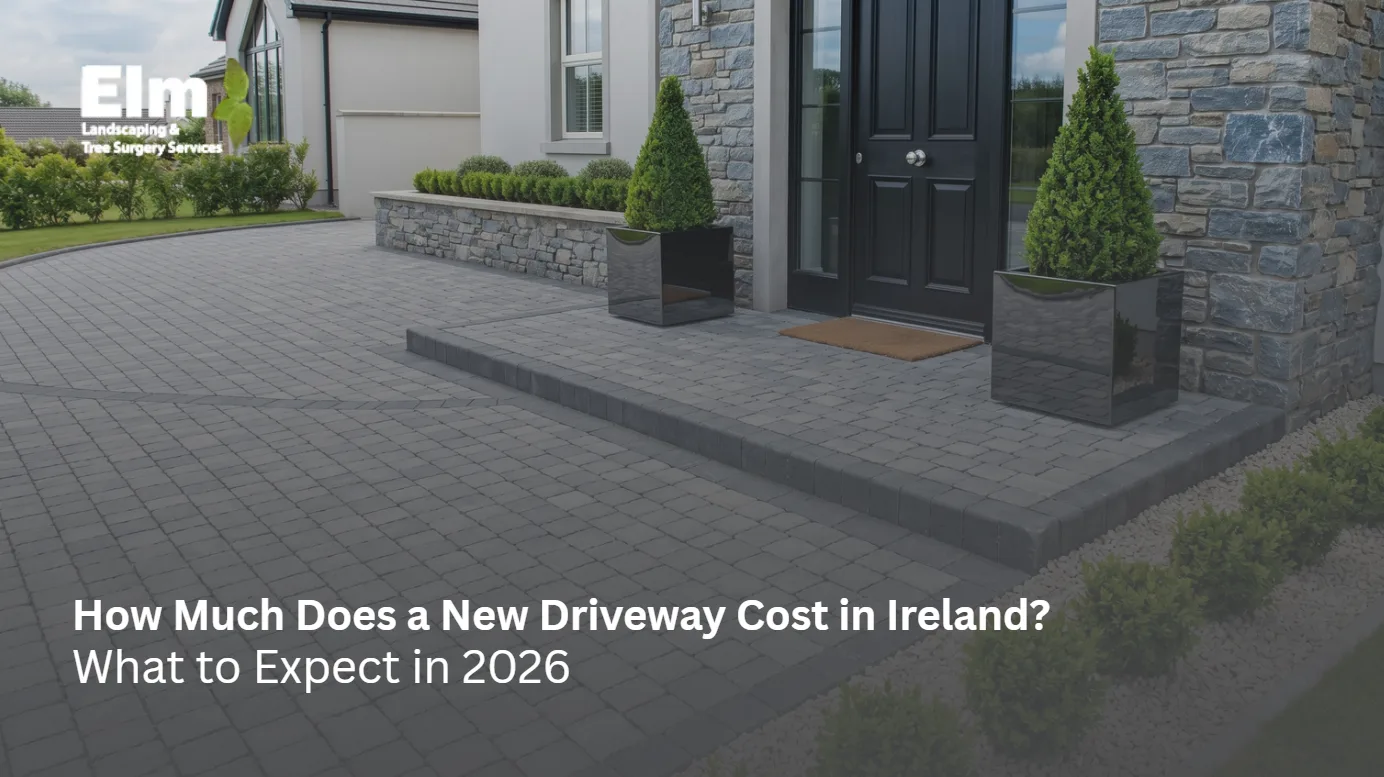
A new driveway cost in Ireland typically ranges from €35 to €200 per square metre, depending on the surface you choose. That range is accurate and almost useless.
Two driveways of identical size, on the same street, finished to the same standard, can come in thousands of euro apart, and the reason has nothing to do with the surface material. That difference is the gap between a driveway that holds up for 20 years and one that needs fixing in five.
New Driveway Cost in Ireland
The most popular driveway surfaces in Ireland and their current installed cost per square metre:
| Surface Type | Cost Per Square Metre (Ireland, 2026) |
|---|---|
| Gravel | €35 to €60 |
| Tarmac | €60 to €90 |
| Block paving | €75 to €120 |
| Concrete driveway | €70 to €110 |
| Resin bound | €90 to €140 |
| Natural stone paving | €120 to €200+ |
These figures cover supply and labour for a properly prepared, fully installed driveway. They do not include old surface removal, drainage upgrades, or dropped kerb work.
For a typical Irish driveway of 50 to 60 square metres, total project costs commonly fall between €3,500 and €8,000, depending on surface choice and ground conditions. As a worked example: a 55 square metre tarmac driveway at €75 per square metre comes to €4,125 for the surface, plus €825 in base preparation at €15 per square metre, for a fully installed total of around €4,950.
The same area in resin bound at €115 per square metre comes to €6,325, plus €1,375 for base work, totalling approximately €7,700.
The gap is real, and what justifies it is addressed surface by surface below. Larger driveways generally benefit from a lower cost per square metre as site setup and mobilisation costs spread across a bigger area.
The Biggest Factors That Drive Driveway Cost in Ireland
The surface material you choose is only part of the equation. The work underneath it accounts for a larger share of the final cost than most homeowners realise, and it is where quotes diverge most dramatically.
Ground preparation is the single biggest variable. If your existing driveway or ground is soft, waterlogged, or sitting on poor subsoil, the base needs to be built up properly before anything goes on top. Excavation, hardcore compaction, and sub-base work typically add €15 to €40 per square metre to a quote.
On a 55 square metre driveway, that is €825 to €2,200 in groundwork alone, before the surface material is even considered. Skipping this step is how cheap driveways become expensive problems within three to five years.
Old surface removal carries costs that many homeowners forget to factor in. Breaking out and disposing of existing concrete paving or tarmac surface adds skip hire, labour, and disposal fees. Budget an extra €10 to €25 per square metre if a full dig-out is required. On the same 55 square metre plot, that adds €550 to €1,375 to the overall project cost.
Drainage is now a compliance requirement under Irish planning regulations, not something contractors can choose to address or skip. Surface water must be managed on-site, either through permeable surfaces or engineered drainage solutions like channel drains or soakaways. A contractor who does not raise this in the initial conversation is worth questioning.
Access matters more than most people realise. If materials can be delivered and tipped close to the work area, a paving job stays efficient. If everything needs to be barrowed through a narrow side gate or around an obstacle, that extra labour time lands on the final invoice.
Finish detailing adds cost faster than most homeowners expect. Kerbing, edging, steps, retaining walls, and decorative borders all add labour. A straightforward rectangular driveway is noticeably cheaper than one with curves, level changes, or feature borders.

How Much Does a Gravel Driveway Cost in Ireland?
Gravel is the cheapest driveway option in Ireland by a meaningful margin, and for the right property it is also the most sensible one.
If you have a rural entrance, a long approach road, or a holiday home where low upfront cost matters more than surface finish, gravel does the job without the project becoming a significant undertaking.
A properly installed gravel driveway costs between €35 and €60 per square metre. That includes excavation, a weed membrane, compacted hardcore, and a gravel finish. At the lower end of that range, you are getting a functional installation. At the higher end, edging, stabilisation grids, and decorative stone push the cost up.
The trade-off with gravel is ongoing maintenance. Stones migrate. Weeds come back through eventually. The surface needs topping up every few years. For a single-car driveway or a rural entrance, the lower installation cost makes sense. For a front driveway on a suburban estate, most homeowners find they eventually want something more permanent.
Gravel driveways cost significantly less than tarmac or concrete paving upfront, but the lifetime maintenance cost narrows that gap over time. Most gravel surfaces need significant topping or repair within five to ten years, which is worth factoring into any honest cost comparison.
How Much Does a Tarmac Driveway Cost in Ireland?
Tarmac is one of the most popular driveway surfaces in Ireland, particularly for larger areas and properties where practicality matters more than decoration. It handles Irish weather well and drains surface water efficiently when properly installed. The finish is clean and functional rather than decorative, which suits most homeowners fine.
The cost of a tarmac driveway in Ireland runs from €60 to €90 per square metre for a full installation including sub-base preparation, edging, and the tarmac surface itself. A new tarmac driveway on a standard 50 square metre plot typically costs between €3,000 and €4,500 fully installed.
Tarmac driveway cost varies depending on base condition. An overlay onto a stable existing surface costs less than a full dig-out and rebuild. If a contractor is quoting significantly below the range above, ask specifically what base preparation is included. A thin tarmac layer on a poor sub-base is one of the most common causes of premature driveway failure in Ireland.
A new tarmac drive is easier to maintain than block paving or resin, but it does show repairs more obviously. With a proper base and occasional resealing every 10 to 15 years, a well-installed tarmac surface can last 15 to 25 years. For property owners in Dublin and other urban areas, tarmac or concrete tends to be specified on larger residential driveways where speed and budget are priorities.
How Much Does Block Paving Cost in Ireland?
Block paving is extremely popular in Ireland because it combines a premium appearance with long-term repairability. Unlike tarmac or concrete, a block paving driveway can be partially lifted and relaid if a section settles or a utility needs access underneath, without leaving a visible scar.
Block paving driveway cost ranges from €75 to €120 per square metre. Standard rectangular blocks in a simple pattern sit at the lower end. Intricate designs, premium block finishes, contrasting borders, and shaped areas push into the upper range.
The big variable with block paving is workmanship. A block paving driveway installed on a shallow or poorly compacted base will sink, shift, and develop an uneven surface within a few years. The blocks themselves are not the problem. The base is always the problem. This is why choosing a paving contractor with a clear process for sub-base depth and compaction matters more than the block brand or colour.
For a driveway in Dublin or other higher-cost urban areas, block paving paving job costs tend to run toward the top of the national range due to higher labour rates and more complex access conditions. In Clare, Limerick, and Galway, the same work generally comes in at the mid to lower end. Installed correctly on a proper base, a block paving driveway can last 20 years or more, with damaged sections replaceable individually rather than requiring a full resurface.
How Much Does a Concrete Driveway Cost in Ireland?
A concrete driveway is the closest thing to a choose-once-and-forget surface in the Irish market. Installed correctly, a concrete surface with proper drainage and expansion joints can last 30 to 40 years without resealing, resurfacing, or significant intervention.
The cost of a concrete driveway in Ireland sits between €70 and €110 per square metre. Imprinted concrete driveways, where patterns and colour are pressed into the surface before it sets, cost more, typically €85 to €120 per square metre. Imprinted or coloured concrete gives the appearance of block paving or stone at a lower maintenance burden, though the sealer requires refreshing every three to five years.
The higher upfront cost of concrete compared to tarmac is the main objection. Over a 20-year horizon, the reduced maintenance and longer lifespan can make concrete paving the more cost-effective choice, particularly for large driveways or properties where a complete resurface would be disruptive and expensive.
One caution: concrete is unforgiving of poor workmanship. Inadequate drainage causes cracking. Insufficient expansion joints cause cracking. Done right, it is the most durable surface available. Done poorly, it is the most expensive mistake on this list.
How Much Does a Resin Driveway Cost in Ireland?
Resin bound driveways have grown consistently in popularity across Ireland over the last five years. The practical reason is permeability: a properly installed resin bound surface lets water pass through it into the ground rather than running off into surface drains, which matters increasingly under current planning regulations. The aesthetic reason is the finish, which is smooth, weed-resistant, and available in a wide range of aggregate colours.
The cost of resin driveway paving in Ireland ranges from €90 to €140 per square metre. The wide range reflects the fact that resin cannot be installed directly on bare ground. It requires a solid sub-base, usually an existing tarmac or concrete surface in sound condition, or a newly prepared one. If your existing driveway needs a full base installation before the resin goes down, the overall cost rises significantly.
Resin is a genuinely low maintenance driveway surface. Occasional cleaning is all it requires under normal conditions. Repairs, however, are more complex than block paving and typically require a specialist. For homeowners who want a clean, modern finish and are willing to spend more upfront to avoid ongoing maintenance, resin is worth serious consideration.
The permeable nature of resin bound surfaces also has a practical planning benefit. In many cases, a fully permeable surface reduces or removes the need for additional drainage planning permission, which can simplify the overall project.
To put the cost difference in concrete terms: a 55 square metre resin driveway at €115 per square metre costs €6,325 for the surface, plus approximately €1,375 for base preparation, totalling around €7,700. A tarmac driveway of the same size at €75 per square metre comes to €4,125 plus €825 in base work, totalling around €4,950. The €2,750 difference is significant. Whether it is justified depends on your drainage requirements, your appetite for future maintenance, and how long you intend to stay in the property.
Natural Stone Driveways: When the Higher Cost Is Worth It
Natural stone paving is the most expensive driveway material available and also the most visually striking when done well. Granite setts, limestone, and sandstone all fall into this category, with cost ranging from €120 per square metre to well over €200 for premium stone with intricate laying patterns.
The price reflects both materials and the skilled labour required to lay stone well. It is slow work. For period properties, high-value homes, or projects where the driveway is as much a design statement as a functional surface, natural stone paving justifies its cost per square metre.
It is not a practical choice for every property, but where budget permits and the property warrants it, a granite sett or limestone driveway is the kind of finish that appears in estate agent photographs. No other surface material comes close to it for first impressions on a period or high-value home. If you are planning both a driveway and an outdoor seating area, our patio cost guide for Clare, Limerick and Galway covers what to expect when combining both projects.

Do You Need Planning Permission for a New Driveway in Ireland?
This is one of the most commonly asked questions about driveway projects in Ireland, and for most homeowners in Clare, Limerick, and Galway replacing an existing driveway, the answer is straightforward: you do not need planning permission. The more complicated cases are new vehicular entrances and impermeable surfaces in areas with drainage scrutiny.
Replacing an existing driveway on a like-for-like basis generally does not require planning permission, provided you are not materially changing the size, the access point to the road, or the drainage arrangements in a way that affects public infrastructure. Most straightforward driveway replacements proceed without a planning application.
Creating a new vehicular entrance from a property onto a public road is a different matter. Planning permission is always required to create a new access point. No exceptions. Your local authority, whether that is Clare County Council, Limerick City and County Council, or Galway County Council, must approve any new dropped kerb or vehicular access construction before work begins. Footpath dishing is carried out by the local authority following planning approval, and fees apply.
Impermeable surfaces and drainage are increasingly subject to planning scrutiny. If your new driveway surface does not allow surface water to drain naturally, or if it directs water onto a public road or footpath, your local authority may require you to demonstrate an adequate drainage plan. This is one reason the shift toward permeable surfaces like resin bound and permeable block paving has accelerated in recent years.
If you are in any doubt about whether your specific project requires permission, a brief conversation with your local authority’s planning or roads department will clarify the position before you commit to any work. Clare County Council, Limerick City and County Council, and Galway County Council each handle dropped kerb and vehicular access applications through their roads departments, and a call or email before you engage a contractor can save significant time and cost if permission turns out to be required.
What a Proper Driveway Quote Should Include
Most people get driveway quotes without knowing what to look for in them. Most homeowners compare quotes by price alone. That is rarely the right filter. Here is what a thorough quotation from a competent paving contractor should cover:
The scope of ground preparation work, including excavation depth and sub-base specification. The drainage solution, whether that is a channel drain, soakaway, or permeable surface. The specific surface material, grade, and thickness. Whether edging and kerbing are included. How old surface removal and disposal is handled, and whether that cost is included or additional. A clear confirmation of what is and is not covered if ground conditions prove worse than expected.
A quote that simply states a lump sum or a per square metre rate without addressing these points is not a complete quote. It is an opening number.
In our experience across Clare, Limerick, and Galway, the quotes that come back with problems at the end of a project are almost always the ones that arrived as a single number. A proper quote takes longer to produce. That is not a warning sign. It is the point.
What Does a New Driveway Actually Cost to Run Over Time?
Most guides focus on installation cost. Few address what it costs to keep a driveway in good condition, which affects the real value of the surface you choose.
Gravel is the most demanding surface to maintain over time. It needs topping up every few years, weed control is ongoing, and most surfaces need significant attention within five to ten years of installation. Tarmac is far more hands-off: a reseal every 10 to 15 years is typically all it needs, and a well-built tarmac surface has a working lifespan of 15 to 25 years.
Block paving lasts 20 years or more with joint re-sanding and occasional patching, and individual blocks can be replaced without disturbing the whole surface. Concrete goes further still, potentially 30 to 40 years with minimal recurring cost, though any repairs are visible and specialist work when they arise. Resin sits between the two: 15 to 25 years, low maintenance, but specialist repairs when needed. Not cheap.
As an illustrative comparison on a 55 square metre driveway, gravel costs around €2,600 upfront but may need €500 in top-up material every five years, adding €1,500 over 15 years. Tarmac at around €4,950 fully installed may need one reseal at around €700 at year ten. Block paving at around €5,350 might need €300 in patching at year seven. Concrete at around €4,950 carries minimal maintenance, perhaps €200 over 15 years. Resin at around €7,700 needs cleaning and around €300 in specialist repairs over the same period.
The figures are illustrative rather than guaranteed, but the direction is consistent: cheaper surfaces close the gap over time, and more durable surfaces hold their value better the longer you stay in the property.
When you are comparing driveway paving costs across materials, factor in a 15-year horizon, not just the day of installation.
New Driveway in Clare, Limerick or Galway? Get a Written Site Assessment
Driveway costs across Munster and Connacht generally come in below the rates quoted in Dublin-based price guides. Labour rates are lower, materials sourced locally are competitive, and site access on rural and suburban properties tends to be less complicated than on tight urban plots. If you have been using Dublin-based figures to budget a driveway project in Clare, Limerick, or Galway, you are likely working with figures that are 10 to 20 percent higher than what local contractors will quote.
In practical terms, a project quoted at €6,000 in Dublin might come in at €4,800 to €5,400 with a Munster-based contractor on a comparable site.
Start with a site visit. Everything useful about a quote depends on someone having seen the ground. Conditions, existing surface state, drainage requirements, and access all need to be assessed in person before any reliable figure can be given.
A site visit gives you a written breakdown of exactly what your project involves: surface options suited to your ground conditions, a clear cost for each, and no items that appear later as surprises. That is how Elm Landscaping has worked since 2008, across Clare, Limerick, Galway, and Tipperary. ISO certified, ISA member, and one of the few landscaping companies in Munster with the machinery and qualified crews to handle both residential and large-scale commercial projects.
Get my written site assessment
Elm Landscaping and Tree Surgery Services Ltd. Serving Clare, Limerick, Galway and Tipperary since 2008. ISO certified. ISA member.